Interview volumes are rising at the same time as university teams face tighter budgets, greater scrutiny and increased pressure to make confident recruitment decisions.
That creates a difficult question: how do institutions increase capacity without weakening the quality or consistency of assessment?
The debate is often reduced to people versus technology. In reality, neither is enough on its own.
Live interviews can provide valuable context and human judgement, but they are difficult to schedule and resource at scale. Technology can create structure and reduce administration, but it should not be expected to interpret every response without professional oversight.
A strong interview process needs both.
Structure supports consistency
Credibility interviews can become inconsistent when different interviewers ask different questions, use different follow-ups or interpret the same criteria in different ways.
A structured framework helps reduce that variation.
Clear questions, agreed assessment criteria and a consistent record of the evidence considered give assessors a shared basis for making judgements. They also make it easier for institutions to review how an outcome was reached.
But structure should not mean adopting a generic process.
Each institution determines the questions, assessment criteria and pass thresholds that reflect its own courses, recruitment markets, policies and risk profile. These can vary across different student groups, with the appropriate question sets and assessment thresholds automatically applied through the platform.
Enroly provides the technology and assessment framework, while each institution retains control over the questions, criteria and pass thresholds applied.
Technology should support judgement
Technology can remove much of the administration surrounding interviews.
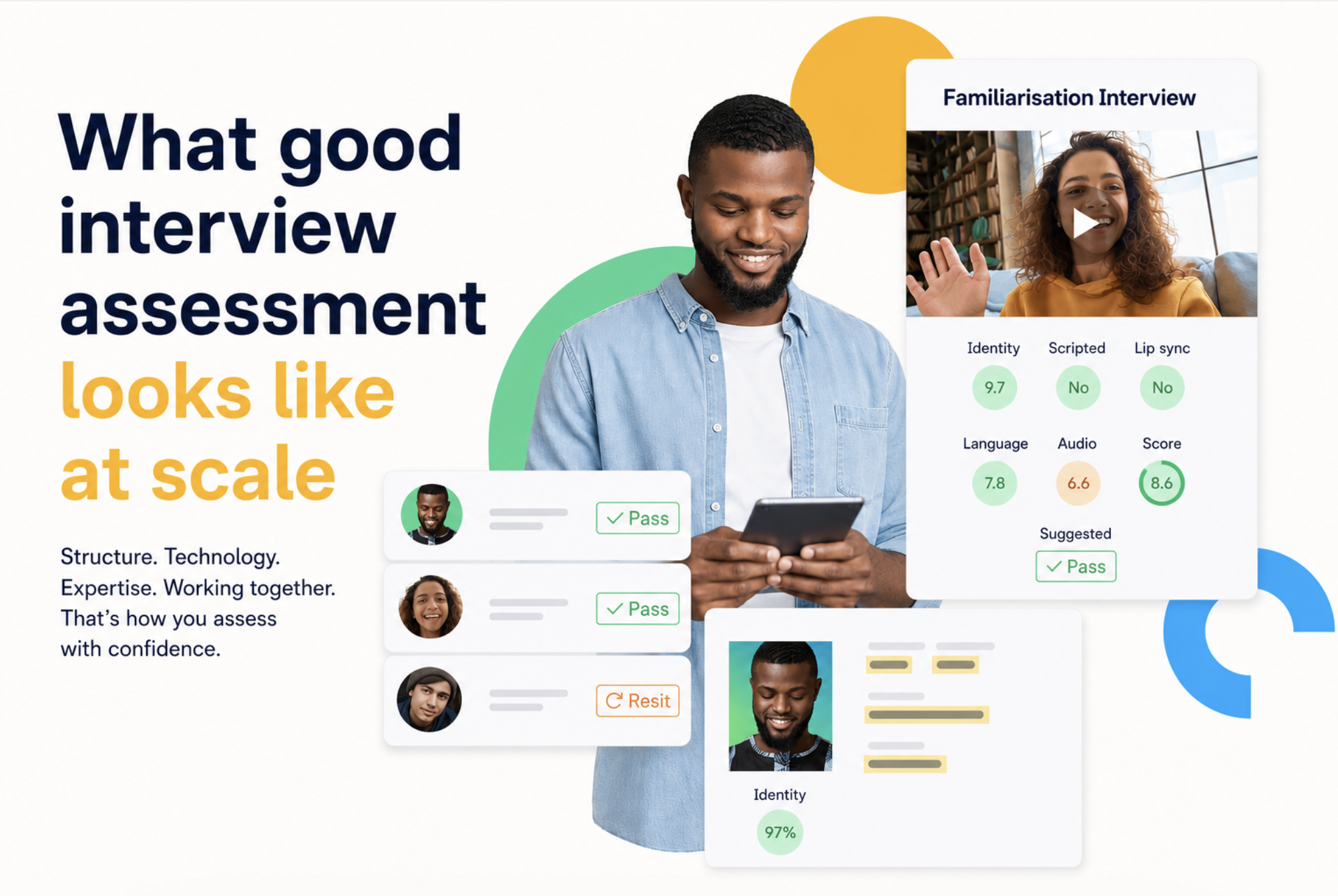
Asynchronous delivery avoids the need to coordinate appointments across countries and time zones. Students can complete interviews at an appropriate time, while recordings, transcripts, evidence and outcomes are brought together within the wider CAS Shield workflow.
Technology also supports a more secure and reviewable process.
Facial recognition and identity checks help institutions confirm who is completing the interview. Natural language processing helps structure responses and highlight areas that may require closer attention. Two transcription methods provide additional support for assessors and strengthen the record available for review.
Enroly’s managed Interview Assessment service also provides an assessment outcome and detailed scorecard to support the institution’s audit trail. But technology should support the assessment, not become the assessor.
Every interview completed through Enroly’s managed service is reviewed by a trained assessor. Technology helps organise the evidence and apply the institution’s framework; the assessor provides the context and professional judgement.
Expertise needs quality controls
Experienced people are important, but expertise alone does not guarantee consistency.
Assessors also need clear guidance, training, moderation and ongoing quality assurance. Differences in interpretation need to be identified and reviewed, rather than becoming embedded in the process.
That is why Enroly has introduced a dedicated Quality Assurance Manager role with a separate remit from the day-to-day line management of the assessment team.
This provides greater focus on moderation, consistency and continual improvement. It creates space to review how institutional criteria are being applied, identify differences and challenge where the process could be strengthened.
As Johnny, our Quality Assurance Manager, explains:
“Having come from Ecctis, managing quality assurance for high-stakes government recognition services for visa applicants, I know the importance of well-run moderation and QA services. It’s been great to see the work Enroly have done to ensure students get a fair and consistent interview assessment – I’m excited to be building on that further as more and more customers come on board.”
The process must keep evolving
Credibility assessment is not static.
As institutions strengthen their processes, the methods used to misrepresent identity or prepare inauthentic responses also become more sophisticated. Interview technology, assessor guidance and quality controls therefore need to continue developing too.
That means investing not only in speed and capacity, but in stronger identity checks, clearer evidence and better ways to identify emerging forms of manipulation.
Technology alone will not solve that challenge. But combined with experienced assessment and effective quality assurance, it can give institutions a stronger and more adaptable process.
Scale should strengthen the process
Scaling interview activity should not mean accepting less visibility, weaker evidence or reduced oversight.
Done well, technology can create a clearer and more reviewable process while allowing experienced people to focus on the areas that require judgement.
The question is therefore not whether interviews should be human or technology-led.
It is whether the process combines clear institutional criteria, experienced assessors, structured evidence and effective quality assurance.
That is what allows institutions to increase capacity without compromising the standard of assessment.
Considering how your interview process could work at scale?
Enroly provides configurable interview technology alongside a fully managed assessment service, helping institutions increase capacity while retaining control of their questions, criteria and pass thresholds.
Explore our Interview Assessment approach and see how it could support your team.
.png)